Table of Contents
Key Takeaways for Risk-Conscious Real Estate Investors (2026)
- Low-risk, high-stability market: Hyderabad offers one of India’s most stable real estate markets with minimal speculative risk.
- Healthy returns without bubbles: Average 10–12% annual price appreciation with no signs of overheating.
- Strong total returns: 15–17% overall returns, combining appreciation (≈12%) and 3–5% rental yields.
- Sustainable price-to-rent ratios: Maintains 20–25 years, far healthier than Mumbai or Bangalore.
- End-user–driven demand: Growth led by genuine housing needs, not short-term speculation.
- Job-led growth engine: IT sector creates 58,000+ jobs annually, supporting consistent housing demand.
- Regulatory safety: RERA compliance improves transparency and reduces developer risk.
- Infrastructure-backed growth: ORR, metro expansion, and planned connectivity strengthen long-term value.
- High affordability advantage: Prices remain 30–40% lower than Bangalore with comparable growth potential.
- Proven resilience: 2025 sales slowdown showed price stability, not market collapse, confirming structural strength.
Bottom line: Hyderabad suits conservative investors seeking steady, predictable returns with controlled risk, not boom-and-bust speculation.
What Defines “Safe” Real Estate Investment?
Safe real estate investment combines three characteristics: capital preservation maintaining purchasing power through inflation hedging, predictable returns delivering steady appreciation and rental income without extreme volatility, and exit liquidity enabling property sales within reasonable timeframes (6-12 months) at fair valuations.
The safety framework evaluates economic stability of the region, employment growth sustaining housing demand, infrastructure development enhancing property accessibility and value, regulatory environment protecting buyer interests, market maturity avoiding boom-bust speculation, and developer credibility ensuring project completion and quality.
Hyderabad’s investment safety isn’t absence of risk, all investments carry risk, but rather manageable, calculable risk offset by strong fundamentals and diversified economic base. This analysis examines whether Hyderabad’s risk-reward profile supports confident long-term investment during uncertain times.
Hyderabad’s Safety Scorecard: Key Stability Indicators
| Safety Metric | Hyderabad Performance | Benchmark/Comparison | Safety Rating |
| Price Appreciation Pattern | Gradual 10-12% annually | Mumbai 5-6%, Bangalore 12-15% (volatile) | ⭐⭐⭐⭐⭐ Stable |
| Demand Composition | 70% end-users, 30% investors | Mumbai 50-50, Bangalore 60-40 | ⭐⭐⭐⭐⭐ End-user driven |
| Unsold Inventory | Low-moderate levels | Mumbai/NCR high overhang | ⭐⭐⭐⭐ Manageable |
| Price-to-Rent Ratio | 20-25 years | Mumbai 40+, Bangalore 30+ | ⭐⭐⭐⭐⭐ Healthy balance |
| Rental Yield | 3.88% (highest metro) | National average 2.9% | ⭐⭐⭐⭐⭐ Superior returns |
| Employment Stability | 58,000+ IT jobs added 2023 | Bangalore 75,000+, Pune 45,000+ | ⭐⭐⭐⭐ Strong growth |
| Affordability | ₹5,500-8,500/sq ft IT corridors | Bangalore ₹9,000-15,000/sq ft | ⭐⭐⭐⭐⭐ Accessible |
| Regulatory Compliance | Strong RERA enforcement | Varies by state | ⭐⭐⭐⭐ Well-regulated |
| Infrastructure Pipeline | Metro Phase 2, RRR, airport expansion | Major projects funded | ⭐⭐⭐⭐⭐ Excellent momentum |
Overall Safety Assessment
Hyderabad scores 4.5/5 stars on investment safety, among the highest for Indian metros. The city presents moderate risk with stable-to-high returns, ideal for conservative long-term investors prioritizing capital preservation and steady growth over aggressive speculation.
Economic Foundation: Why Hyderabad Remains Resilient
IT Sector: The Employment Engine
Hyderabad’s IT sector employs 800,000+ professionals across technology, life sciences, pharma, and business services, creating housing demand that weathers economic uncertainties better than markets dependent on single industries or speculative investment.
Diversification Within IT: Unlike Bangalore’s heavy software focus, Hyderabad spans software development, global capability centers (GCCs), life sciences, pharmaceutical research, aerospace, and defense, reducing single-sector concentration risk.
Corporate Expansion: Major tech giants continue Hyderabad expansion. Microsoft, Google, Amazon, Apple, and emerging AI companies are establishing or expanding operations, with 58,000+ jobs added in 2023 alone. This corporate commitment signals long-term confidence transcending short-term economic cycles.
GCC Growth: Hyderabad has become one of India’s fastest-growing hubs for Global Capability Centres, with multinational companies continuing to expand operations. GCCs provide high-quality jobs with stable career paths, creating reliable housing demand from professionals seeking long-term residences rather than transient accommodations.
Government Stability and Vision 2047
The state government has launched Telangana Rising 2047 action plan, aiming to transform the state into a $3 trillion economy by 2047. This plan includes the development of specialised zones such as AI City, Sports City, and Life Sciences and Health City, providing 20+ year development roadmap that reduces policy uncertainty.
Investor-Friendly Governance: Telangana’s TS-iPASS single-window clearance system and pro-business policies have attracted ₹1+ lakh crore investments since state formation in 2014. Governance stability and bureaucratic efficiency create conducive environment for sustained real estate development.
Infrastructure Commitment: Government capital expenditure on roads, metro, water supply, and urban development continues despite economic headwinds, protecting property values through connectivity improvements and livability enhancements.
Looking for a Home That Reflects Your Lifestyle?
Discover thoughtfully designed homes by Kura Homes — where timeless architecture, modern comfort, and sustainable living come together.
Market Maturity: Avoiding Speculative Bubbles
End-User Driven Demand (70% vs. 30% Investors)
Employment-led demand has been a critical differentiator for the city. Residential absorption is closely linked to end-use requirements rather than short-term investment sentiment, helping maintain market balance even during periods of economic uncertainty.
What This Means: In cities where 50-60% of purchases come from investors, prices can rise rapidly during optimism and crash during pessimism, creating boom-bust cycles. Hyderabad’s 70% end-user base (buying for self-use) creates natural demand floor preventing severe corrections.
COVID-19 Case Study: During 2020-2021 when speculative markets crashed, Hyderabad prices remained stable or grew modestly. End-users don’t panic-sell during downturns, they continue living in their homes, preventing inventory flooding that destroys prices.
Controlled Price Appreciation
Unlike several Indian cities that experienced sharp boom-and-bust cycles, Hyderabad has followed a relatively measured growth trajectory. Price appreciation across key micro-markets has remained gradual, driven largely by real demand rather than speculative activity.
Historical Pattern: Hyderabad avoided the 2008-2013 crash that devastated NCR and Mumbai because it never experienced irrational exuberance in 2005-2008. Since 2015, appreciation has consistently tracked GDP growth, employment addition, and infrastructure development, indicators of fundamental value rather than speculation.
2025 Market Correction: When sales volumes declined 6% year-over-year in Q2 2025, prices remained stable rather than collapsing. This demonstrates market maturity, excess speculation is wrung out through volume adjustments rather than price crashes that devastate investor wealth
Infrastructure: The Connectivity Advantage
Outer Ring Road (ORR) Impact
The 158-kilometer Outer Ring Road transformed Hyderabad’s real estate landscape by connecting peripheral corridors to employment hubs in 35-45 minutes versus 90+ minutes pre-ORR. This infrastructure unlocked developable land while maintaining accessibility, creating affordable housing options without sacrificing connectivity.
Investment Safety Implication: Properties within 3 kilometers of ORR access points appreciated 25-35% faster than interior locations (2021-2024), confirming infrastructure’s role in de-risking peripheral investments. Even during market slowdowns, well-connected properties maintain value.
Metro Rail Expansion
Metro Phase 1 (operational) and Phase 2 (under construction) create transit-oriented development opportunities. Properties within 2-kilometer radius of metro stations appreciated 22% more over five years than poorly connected areas, per Knight Frank 2023 study.
Phase 2 Significance: Airport Express line and extensions to Kokapet, LB Nagar, and suburban areas will reduce commute times by 40-50%, making previously peripheral zones mainstream residential options. This pipeline ensures sustained appreciation drivers for next 5-7 years.
Regional Ring Road (RRR) and Future Projects
The proposed 340-kilometer Regional Ring Road will create outer connectivity ring, while Hyderabad Growth Corridor and Pharma City developments expand the city’s economic footprint. These mega-projects, though 5-10 years from completion, provide long-term appreciation tailwinds reducing downside risk for patient investors
Affordability: The Sustainable Growth Enabler
Price Comparison with Peer Cities
| City | Average Price (IT Corridors) | Affordability Index |
| Hyderabad | ₹6,000-11,000/sq ft | 100 (baseline) |
| Bangalore | ₹9,000-15,000/sq ft | 60-70 (less affordable) |
| Mumbai MMR | ₹15,000-35,000/sq ft | 25-40 (significantly less) |
| Gurgaon | ₹9,000-20,000/sq ft | 50-65 (less affordable) |
| Pune | ₹7,000-12,000/sq ft | 80-90 (comparable) |
Safety Insight: Hyderabad’s 30-40% price discount versus Bangalore despite comparable job growth creates headroom for sustained appreciation without affordability crisis that constrains other markets. When prices remain accessible to target buyers, demand remains robust, protecting downside.
Income-to-Price Ratio
Average IT professional salaries in Hyderabad (₹8-15 lakh) can afford 2-3BHK apartments (₹60-90 lakh) with reasonable EMI burdens (30-40% of income). This affordability ensures continuous first-time buyer entry, the market segment that provides liquidity and prevents stagnation.
Contrast: Mumbai’s income-to-price ratios make homeownership impossible for many professionals, forcing permanent rental status. This weakens long-term demand and creates vulnerability during economic downturns.
Rental Yield: Income Safety Net
India’s Highest Metro Rental Yield
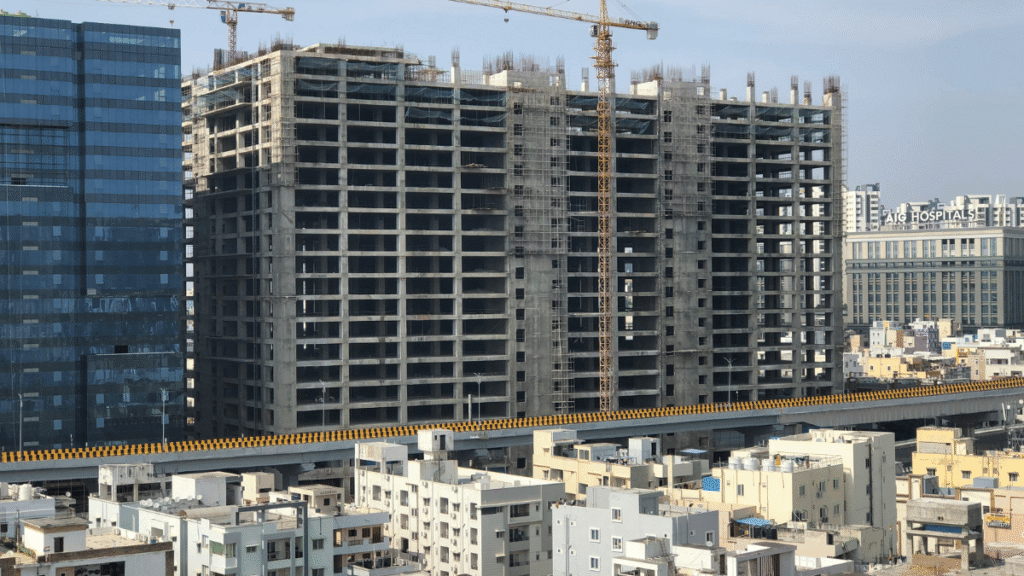
Hyderabad currently boasts an average rental yield of 3.88%, surpassing the national average of 2.9%. This superior yield provides income buffer during appreciation slowdowns, if capital gains pause, rental income continues generating returns.
IT Corridor Yields: Areas like Gachibowli, HITEC City, and Kondapur deliver 4-5% rental yields on residential properties, comparable to commercial real estate in other cities. High-income tenants create stable rental demand even during economic uncertainty.
Rental Growth Trajectory
Between 2021-2024, HITEC City rental values grew 54% while Gachibowli saw 62% rental appreciation. This rent growth accompanies capital appreciation, providing dual return streams that compound wealth effectively.
Investment Implication: Properties purchased in 2021 at ₹70 lakh now worth ₹1.1 crore (62% capital gain) while generating ₹25,000-30,000 monthly rent (₹3 lakh annually = 4.3% yield on original price). Total five-year return exceeds 80%, demonstrating how rental yield cushions market volatility.
RERA Compliance: Regulatory Safety Net
Transparency and Accountability
RERA implementation enhanced transparency and accountability in Hyderabad’s property market. Developers are increasingly focused on timely delivery, disclosure compliance, and financial discipline. Mandatory project registration requires developers to disclose project timelines, land ownership, financial details, carpet areas, and quarterly progress updates.
Key Protections:
- 70% of buyer funds held in escrow accounts preventing fund diversion
- 5-year defect liability period for construction quality
- Penalties for delays or false advertising
- Standardized sale agreements eliminating hidden clauses
- Dedicated RERA authority offering faster dispute resolution than civil courts
Safety Impact: RERA dramatically reduced project abandonment and developer fraud, historically major risks in Indian real estate. Buyers can now verify credentials and track progress, reducing information asymmetry that previously enabled malpractice.
Developer Credibility
Hyderabad’s market features established developers with 15-30+ year track records, Prestige, My Home, Aparna, Ramky, and others, alongside strong regional players. This mature developer ecosystem reduces execution risk compared to markets dominated by fly-by-night operators.
Due Diligence: Investors can visit multiple completed projects, interview existing residents, and verify delivery timelines, making informed developer selection possible. This contrasts with emerging markets where developers lack proven track records.
Looking for a Home That Reflects Your Lifestyle?
Discover thoughtfully designed homes by Kura Homes — where timeless architecture, modern comfort, and sustainable living come together.
Risk Factors and Mitigation Strategies
Understanding Hyderabad’s Risks
No investment is risk-free. Hyderabad’s risks include IT sector dependency creating vulnerability if tech industry faces prolonged downturn, peripheral oversupply in some emerging corridors creating temporary price stagnation, infrastructure delays potentially postponing appreciation in affected areas, environmental challenges including flooding in low-lying areas during monsoons, and interest rate sensitivity affecting affordability and demand during rate hike cycles.
Risk Mitigation Framework
Diversification Strategy:
- Mix established corridors (Gachibowli, HITEC City) with emerging zones (Kokapet, Tellapur)
- Combine apartments with plot investments for different appreciation timelines
- Spread investments across 2-3 properties rather than single large purchase
Location Selection:
- Prioritize ORR-connected locations ensuring baseline connectivity
- Choose areas with multiple employment zones (not single IT park dependency)
- Verify flood history and elevation through municipal records
- Select gated communities with proven society management
Developer Due Diligence:
- Verify RERA registration on TS-RERA portal before booking
- Inspect 2-3 completed projects assessing quality and timeline adherence
- Research online reviews and complaint histories
- Confirm financial backing through bank partnerships
Timeline Management:
- Adopt 7-10+ year investment horizons enabling market cycle navigation
- Maintain emergency funds covering 12 months EMI for income disruptions
- Avoid over-leveraging, keep EMI under 40% of household income
- Plan exit strategies considering resale liquidity
Long-Term vs. Short-Term Investment Perspective
The 3-5 Year Outlook (Medium-Term)
Expected Scenario: Continued moderate appreciation (8-10% annually), stable rental yields (3.5-4.5%), completion of Metro Phase 2 enhancing connectivity, and maturation of Kokapet and Financial District as established corridors.
Risk Factors: Potential interest rate fluctuations, temporary oversupply in specific micro-markets, global economic uncertainties affecting IT sector expansion.
Suitable For: Investors seeking steady appreciation without extreme volatility, homebuyers planning 5+ year residence, and those prioritizing rental income alongside capital gains.
The 7-10 Year Outlook (Long-Term)
Expected Scenario: Regional Ring Road completion transforming peripheral areas, Telangana Vision 2047 milestones (AI City, Life Sciences hub) generating new employment zones, Hyderabad emerging as top-3 Indian metro by economic output, and property prices approaching Bangalore/Pune levels with sustained appreciation.
Risk Factors: Climate change impacts on urban planning, disruptive technologies altering employment patterns, national economic policies affecting real estate sector.
Suitable For: Wealth accumulation through forced savings, retirement planning via rental income, intergenerational asset transfer, and patient capital seeking inflation-protected returns.
Looking for a Home That Reflects Your Lifestyle?
Discover thoughtfully designed homes by Kura Homes — where timeless architecture, modern comfort, and sustainable living come together.
Comparative Risk Assessment: Hyderabad vs. Other Investment Options
Real Estate vs. Equity Markets
Volatility Comparison: Compared to stocks and cryptocurrencies, property offers physical security and predictable returns over time. While equity markets can decline 20-40% within months, Hyderabad real estate rarely sees annual declines exceeding 5-8% even during severe downturns, and those are temporary before recovery.
Liquidity Trade-off: Equities offer T+2 day liquidity; real estate requires 6-12 months. However, this illiquidity often benefits investors by preventing panic selling during volatility, forced patience allows markets to recover.
Real Estate vs. Gold
Gold provides inflation hedge and liquidity but generates zero income. Hyderabad real estate offers inflation protection through appreciation, rental income (3-4% annually), and tax benefits (80C, 24b deductions), creating superior total returns.
10-Year Comparison: Gold averaged 8-9% annual returns; Hyderabad real estate delivered 12-15% (appreciation + rental yield). The income component significantly enhances wealth accumulation.
Real Estate vs. Fixed Income
Fixed deposits and bonds deliver 6-7% returns with high safety but minimal inflation protection. Hyderabad real estate’s 12-15% total returns meaningfully outpace inflation (5-6%), preserving and growing purchasing power, critical for long-term wealth.
Tax Efficiency: Real estate allows 30% rental income deduction, interest deductions, and indexation on capital gains. Fixed income faces full taxation at slab rates, creating 8-12% tax efficiency advantage for real estate.
Is Now the Right Time? 2026 Market Entry Analysis
Arguments for Investing in 2026
Market Correction Creating Entry: The 6% sales volume decline in 2025 created buyer-favorable conditions without price crashes. Quality inventory available with negotiation leverage, ideal for value-conscious investors.
Interest Rate Stabilization: After 2022-2024 rate hikes, RBI has begun cutting rates. Further cuts expected in 2026 improving affordability and reducing EMI burdens, creating demand tailwinds.
Infrastructure Momentum: Metro Phase 2 nearing completion, RRR construction commencing, and major corporate expansions proceeding despite uncertainty. These long-term drivers ensure appreciation continuation.
Affordability Window: Hyderabad remains 30-40% cheaper than Bangalore despite comparable growth, this pricing gap will narrow over 5-7 years as Hyderabad matures. Early entry captures maximum appreciation.
Arguments for Waiting
Global Economic Uncertainty: Geopolitical tensions, recession fears in Western economies, and policy uncertainties create caution. Waiting 6-12 months may provide greater clarity.
Interest Rate Trajectory: While rate cuts likely, inflation persistence could delay reductions. Higher-than-expected rates would pressure affordability and demand.
Oversupply in Pockets: Luxury segment (₹2 crore+) shows 6% inventory increase, indicating potential corrections in ultra-premium category. Mid-segment remains balanced.
The Verdict: Time-in-Market Beats Timing-the-Market
Historical data confirms that trying to time perfect market entry often results in missed opportunities. A property purchased in 2021 “before correction” at ₹70 lakh is worth ₹1.1 crore in 2026 despite interim volatility, demonstrating that long holding periods overcome entry timing imperfections.
Recommended Approach: If financial capacity exists (down payment + EMI sustainability + emergency fund), begin research and shortlisting now. Invest across 6-12 months rather than lump sum, diversifying entry timing. This dollar-cost-averaging approach reduces timing risk while capturing market exposure.
Frequently Asked Questions (FAQs)
1. Is Hyderabad safer than Bangalore or Mumbai for long-term investment?
Yes. Hyderabad offers similar appreciation (10–12%) with 30–40% lower prices than Bangalore and better rental yields (~3.8%) than both cities, without Mumbai’s overvaluation risk.
2. What if the IT sector slows down?
Impact would be limited. Hyderabad has diversified employment, 70% end-user ownership, and 3–4% rental yields. Even in a severe IT slowdown, prices may grow slower, not crash.
3. How do global crises affect Hyderabad property?
Historically resilient. Past crises caused temporary 5–10% corrections or flat periods, followed by recovery. Domestic demand and low leverage provide insulation.
4. Should I invest if I plan to move abroad in 5–7 years?
Yes, if holding 7–10 years. Strong rentals, appreciation, and rupee depreciation favor NRIs. Use property management and comply with repatriation rules.
5. How liquid is Hyderabad real estate?
Good properties sell in 3–6 months; average in 6–12 months. Urgent sales may require 10–15% discount. Avoid forced selling.
6. Does climate change increase risk?
Yes, location matters. Avoid flood-prone areas, choose elevated, well-drained, water-secure, green-certified projects for long-term safety.
7. How do I assess developer reliability?
Check TS-RERA registration, past completed projects, resident feedback, legal history, and financial strength. Avoid unregistered or delay-prone developers.
8. Is real estate a good inflation hedge?
Yes. Property prices and rents outpace inflation, while loan EMIs become cheaper in real terms. Hyderabad has consistently beaten inflation.
Conclusion: Hyderabad’s Safety Case for Patient Capital
The question “Is Hyderabad safe for long-term investment?” yields a qualified but confident yes, Hyderabad offers one of India’s most balanced risk-reward profiles for patient, informed investors.
The Safety Case Rests On:
Economic Diversification: While IT-centric, Hyderabad spans technology, pharma, aerospace, government, and emerging sectors creating resilient employment base that weathers sector-specific downturns.
End-User Demand: 70% self-use buyers create demand floor preventing speculative crashes common in investor-heavy markets.
Measured Appreciation: 10-12% annual growth driven by fundamentals, not froth, sustainable trajectory avoiding bubble-bust cycles.
Affordability Advantage: 30-40% lower prices versus Bangalore maintain accessibility ensuring continuous buyer entry and demand renewal.
Superior Rental Yields: 3.88% yields (India’s highest metro) provide income buffer and demonstrate genuine demand strength.
Infrastructure Momentum: Metro expansion, ORR completion, and RRR pipeline ensure connectivity improvements that underpin long-term value.
Regulatory Framework: RERA compliance and mature developer ecosystem reduce execution risk and fraud vulnerability.
Three Investor Archetypes Hyderabad Serves:
Conservative Wealth Preservers: Seeking inflation-protected, low-volatility returns (8-10% annually) without stock market sleeplessness, Hyderabad’s gradual appreciation and rental income deliver exactly this.
Moderate Growth Seekers: Balancing safety with meaningful appreciation (12-15% total returns), Hyderabad’s established corridors provide both through end-user demand and infrastructure enhancements.
Patient Capital Builders: Willing to accept 7-10 year horizons for maximum wealth accumulation, Hyderabad’s emerging corridors (Kokapet, Tellapur) offer highest upside while manageable risk through diversification.
The Uncertain Times Context:
During global volatility, geopolitical tensions, and economic uncertainty, Hyderabad’s stability becomes asset rather than liability. Markets that rose too fast crash hardest; Hyderabad’s measured growth creates cushion. Domestic demand drivers insulate from global capital flight. End-user base prevents panic-driven liquidations.
Final Verdict: For investors asking “Where can I safely park ₹50 lakh-2 crore for 7-10+ years and expect capital preservation, steady growth, and income generation?”, Hyderabad deserves serious consideration. It won’t deliver explosive 30%+ annual returns (red flag indicating speculation), but will likely compound wealth at 12-15% annually with manageable volatility, outcome that creates millionaires through discipline, not lottery tickets.
The safest real estate investment isn’t risk-free, it’s risk-proportional to fundamentals. Hyderabad’s fundamentals are sound, diverse, and improving. That makes it safe enough for patient capital seeking generational wealth, even during uncertain times.
Build Your Future on Foundations That Have Weathered Decades
Kura Homes brings nearly five decades of Hyderabad real estate experience spanning economic booms, recessions, policy changes, and market cycles. Our survival and growth through 49 years demonstrates resilience that comes from quality construction, transparent practices, timely delivery, and customer-centric values that transcend market volatility.
We understand that in uncertain times, investors seek not just properties, but partners who prioritize long-term value over short-term gains, who build for generations rather than transactions, and whose reputation rests on delivering on promises consistently across decades.
Whether market conditions are euphoric or cautious, our commitment remains unchanged: creating homes worthy of your trust and confidence, built to serve your family through all seasons.
Explore investments backed by generational expertise and proven resilience. Connect with Kura Homes today.
Discuss Your Investment Strategy →
Disclaimer: Investment analysis, risk assessments, and return projections reflect 2025-2026 market data and may vary based on specific properties, locations, economic conditions, and unforeseen events. This article provides educational analysis, not personalized investment advice. Past market performance does not guarantee future returns. Prospective investors should conduct independent due diligence, verify all claims through official sources, assess personal risk tolerance and financial capacity, and consult qualified financial advisors, property lawyers, and tax professionals before making investment decisions. Real estate investments carry risks including capital loss, liquidity constraints, and market volatility.